WIND TURBINES – VIBRATION ANALYSIS


WIND TURBINES – VIBRATION ANALYSIS
With Government insistence on Renewable Energy, due to a continuing threat of global warming, and growing demand for power, we are sure to see an increase in the number of wind turbines around the world.
Wind turbines are remarkable machines. They are designed to operate, unmanned, in very windy locations; typically in remote farmland or at sea. As the wind blows, the yaw control points the blades into the wind, and the pitch of the blades is constantly varied to control the speed. Typically two large bearings support the main shaft driven by the blades. A gearbox increases the speed in order to drive the generator at 1500 RPM, for example.


Difficulties involved in Maintenance & Vibration analysis of WIND MILL
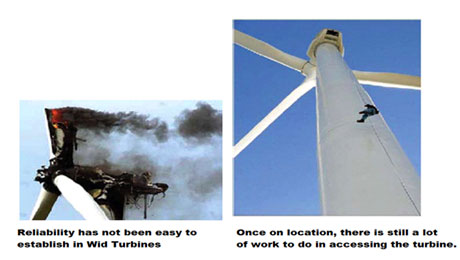
Vibration Analysis plays an important role in ensuring Reliability of a Wind Mill. But the analysis of Wind Mill is complex due to the following factors.
1. Variable speed and load from one test to the next. It is very, very challenging to
acquire Data that can be compared to previous readings in order to detect changes in the patterns.
2. Difficult and limited machine accessibility.
3. Presence of Complex gearboxes - planetary gearboxes being the worst.
4. Very low speed shafts
5. Vibration Data Collection is very laborious since the analyst has to climb the tall tower to Access the bearing locations.
6. The wind conditions are constantly changing, so each vibration measurement taken could potentially be at a different speed and load condition. And what is worse is that the speed can vary as the blades rotate. Even the nacelle (the house at the top of the tower) will rotate as the wind direction changes. And one more small challenge is that the whole structure can vibrate and resonate due to the construction of the tower and nacelle.
7. Therefore, routine monitoring by vibration analysts visiting the wind turbines on a routine basis is almost out of the question.
8. Replacing bearings or a gearbox can be a very expensive operation. In addition to the significant parts cost, transporting and erecting a crane in order to access the turbine adds to the cost, and extends the downtime period
9. Resonance of the blades and tower can contribute to reliability issues, and misalignment is a significant issue given the flexibility of the foundations.
WIND TURBINE MONITORING SYSTEM
NAJLA IBRAHIM AL-THUNAYAN EST utilizes ONEPROD KITE intended for continuous vibration monitoring of wind turbines. By detecting faults at an early stage, production uptime can be increased thanks to scheduled and targeted maintenance. Embedding ONEPROD’s 30+ years of experience in condition monitoring, KITE offers unrivalled diagnosis capabilities on the low-speed rotating components. Its extensive processing power makes it possible to monitor wind turbines with high accuracy, despite their variable operating conditions.
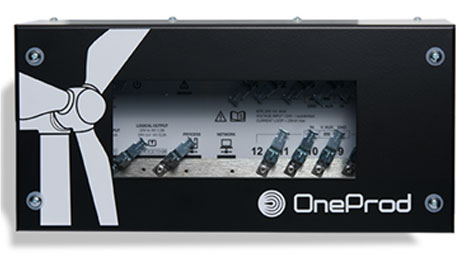
KITE offers 12 data acquisition channels. All information needed for relevant monitoring of the drive train and nacelle can be connected to KITE: accelerometer, tachometer, and 4-20 mA or DC inputs for process information.
In addition, parameters available in the PLC, such as wind speed, power, pitch, yaw, temperature, can be collected without any extra channel in numerical format.
RELIABLE MONITORING OF LOW-SPEED PARTS
ONEPROD KITE offers early fault detection capabilities on the low-speed rotating parts of the wind turbine, thanks to a unique set of tools designed for analysis in the time domain:

ASSISTANCE TO DECISION-MAKING
The latest diagnostics and maintenance recommendations are available in real time and from anywhere worldwide in the ONEPROD NEST software.
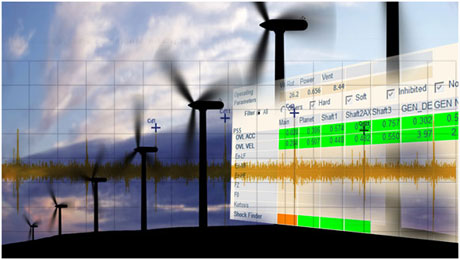
Shock Finder™
Wind turbines are isolated machines that are not readily accessible but that entail significant maintenance challenges. Condition-based maintenance of such equipment is essential so as to achieve annual production objectives. Such maintenance is also a powerful tool in improving the management of spare parts.
Accurate diagnosis of low speed parts with the time domain analysis. Classical techniques have reached their limits for wind turbines analysis and especially low speed parts monitoring, mainly for 2 reasons:
1. To be performed in a reliable way, frequency domain analysis must be done in strictly steady speed conditions. The quick variation of speed and load of the wind turbine cannot be managed correctly as the acquisition time required to monitor low speed parts is important (20 seconds typical with state-of-the-art best practices).
2. Low energy phenomenon resulting from shocks on low speed parts can hardly be detected To counter these weaknesses, ONEPROD KITE provides indicators automatically processed in the time domain, such as the smart ONEPROD Shock Finder™ Algorithm (SFI), or bandkurtosis providing smooth alarming.

RELIABLE SHOCK DETECTION
With ONEPROD Shock Finder™, the fault detection is automatic, even on low speed components such as low speed parts of gearboxes:
1. It is not sensitive to random shocks that may result from impulsive and not repetitive phenomenon. Only shocks maintained over the time can trigger an alarm.
2 As the algorithm is processed in the time domain, it is not affected by the variable process conditions (speed, load…)
3 It offers reliable detection in the low frequency domain (gears) even for the detection of low energy phenomenon hidden in the overall vibration of the machine
EASY DECISION MAKING
The results provided by the Shock Finder are:
1 Binary information on the presence of abnormal shocks (Green / Yellow indicator), warning the vibration analyst of the presence of shocks the number of shocks detected.
2 The filtered signal to determine the origins of the shock phenomenon automatically detected.
The ONEPROD Shock Finder™ allows detecting bearing and gear defects at fairly early stage, and can be used as good complement to classic techniques: Some defects may only be detected by the Shock Finder™, and it can also confirm the results shown by other indicators and make the decision process easier on the diagnostic of critical machinery.
The use of the Shock Finder™ helps reducing the number of sensors needed and the cost of condition monitoring of critical machines. The benefits are:
• The use of standard accelerometer even for the monitoring of low speed components.
• The monitoring of unbalance phenomena and ball bearing defect with a single accelerometer.
• No need for phase measurement with a tachometer thanks to the analysis in the time domain
Classic techniques of vibration analysis, based on the frequency domain, have shown their limit mainly for 2 reasons:
• For variable speed machines, where measurement needs to be done in stable conditions.
• And for low speed rotating parts, where faults can result in very low energy phenomenon and are hardly detectable…
ONEPROD has developed in 2008 and based on real industrial application, a specific indicator analyzing the time domain – to get variation-free indication – in order to detect automatically abnormal shock phenomenon on low speed and variable speed machines: the ONEPROD Shock Finder™.
1. Automatic shock detection with the Shock Finder algorithm (presence and number of shocks).
2. Band-Kurtosis providing smooth alarming.
3. Various post-processing tools, such as filters and statistical indicators
Acquisition is performed synchronously on all channels, providing easier analysis and better diagnosis capabilities.

Compact, waterproof and dustproof to grade IP51, ONEPROD KITE can be installed in the nacelle without any enclosure.
KITE can be easily mounted on a DIN-rail. Visual assistance is marked on the product to provide quick and reliable cabling.

DESIGNED FOR THE WIND INDUSTRY
Compliant with the latest ECM requirements, KITE is resistant to lightening impacts and to the electromagnetic disturbances of the wind turbine. Measurements are reliable, thus enabling accurate monitoring of the wind turbine.